Pentax *istD and focal length
24th October 2003
When the specifications for a digital camera, such as the Pentax *istD, mention the effective focal length being 1.5x many get confused over what this really means. Hopefully you should get a better idea of what is happening and why this “magic” figure of 1.5 is quoted.
Inside the camera
First of all, imagine you can see directly inside the camera, looking straight through the lens. The lens will cast a circular image – remember the lens is not rectangular – all around the sensor. This is what happens:
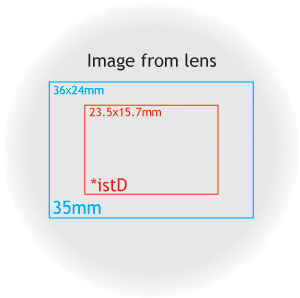
This diagram shows the “sensor” for 35mm film in blue – a target area of 36x24mm. Of course, the image will fade off at the edges of the circle, but the film will ‘pick up’ a rectangular region of that image – making the photograph. (This is why the inside of the camera is matt-black. If it was shiny the reflections from the image outside the film area could be directed back onto the film.)
The digital sensor sits right in the middle of where the 35mm film would have been. Since silicon is so expensive (and indeed has to be grown as a large crystal), most digital cameras use non-full frame CCDs (or CMOS sensors in Canon’s case). The Pentax *istD has the same Sony-made sensor as the Nikon D100, and measures 23.5x15.7mm.
So, do you want to know how your favourite lens behaves on the *istD? Take a 35mm full frame image and produce a centre-crop as shown in the image.
Angle of view
Now we come to the “multiplier” business. To explain this, we need to look at a cross section of the camera and lens. The following image shows this:
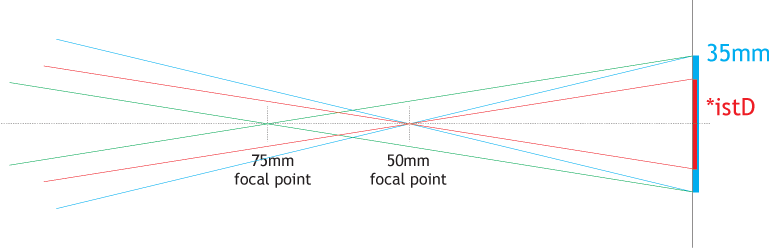
Now, to explain… The 35mm image area is shown in blue – a height of 24mm. For the time being, ignore the “75mm focal point”.
Follow the blue lines and you will see them slice through the 50mm focal point. What lens is in use? A 50mm standard lens, of course! You can see those blue lines travel through that focal point and produce an angle of view on the other side.
Now take a look at the red, *istD, lines. You see they go through the same 50mm focal point, but as the sensor area is smaller than the 35mm film area they result in a narrower angle of view. In other words, using a 50mm lens on an *istD will not fit as much of the original scene in as a film camera would using the same lens.
Finally, take a look at the green lines. These converge on a different focal point – the 75mm focal point. They represent a film camera using a 75mm lens. What is interesting is that the green lines and the red *istD lines are parallel, they have the same angle of view. Consequently, a 75mm lens on a film camera will record the same amount of the original scene as the *istD would using a 50mm lens.
This is why the *istD has an effective focal length of 1.5x
Hope that explains a little J
If you have any comments on this document, or would like to reproduce any of the article, please email me at info@photon.me.uk